
Why Voter ID and a Citizenship-Based Census Terrify the Left
Voter ID threatens fraud. A citizenship-based census threatens inflated power. Together, they threaten a system built on murky numbers and manufactured outrage. This isn’t about access — it’s about control.
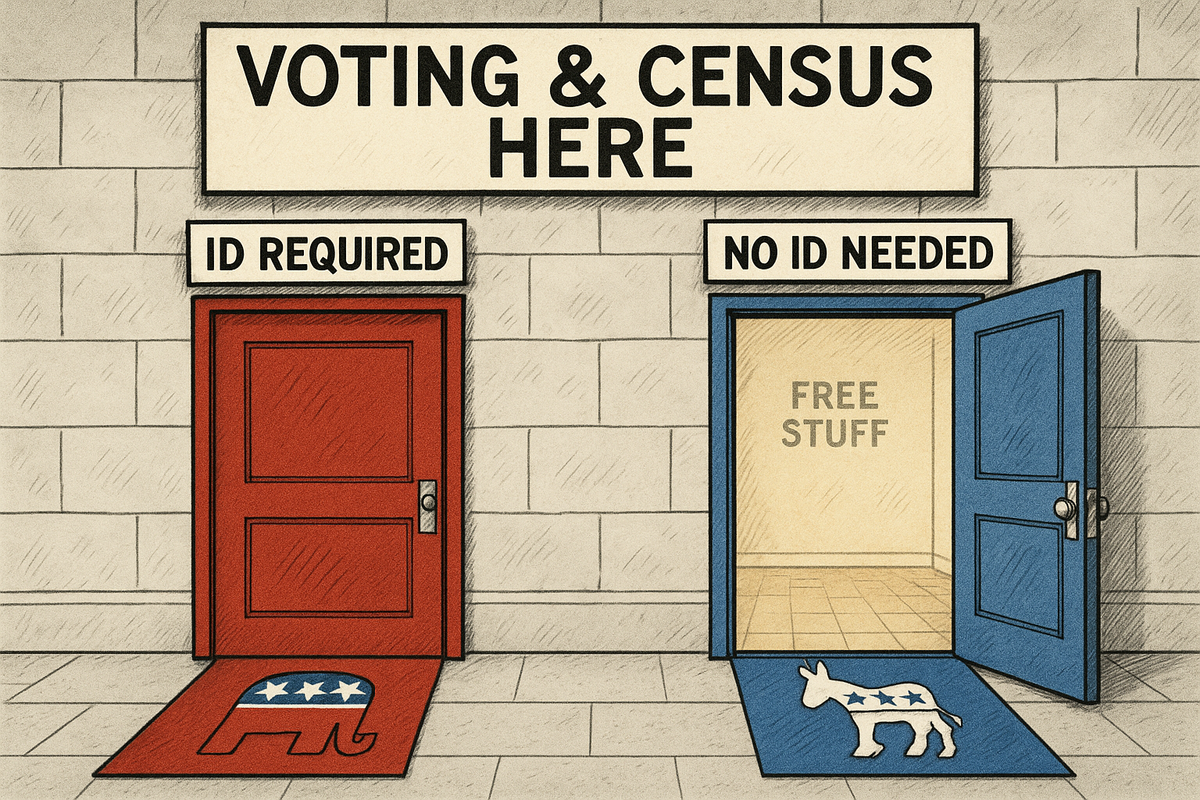
From free driver’s licenses for undocumented residents to claims that people “might not be able to find the DMV,” the opposition to voter ID isn’t about fairness — it’s about control.
And the same goes for the census. When representation and federal funding are based on total population — including millions who aren’t citizens — demanding accuracy is treated like an attack.
In both cases, the fight isn’t about inclusion. It’s about preserving an edge. Voter ID threatens fraud. A citizenship-based census threatens inflated power. Together, they threaten a system built on murky numbers and manufactured outrage.
We’d love to present this as a nonpartisan issue — and in a sane world, it would be. But when one side fights basic accountability at every turn, it becomes impossible to ignore who’s standing in the way.
The Manufactured Panic Over Voter ID
Let’s start with the obvious: the overwhelming majority of Americans support voter ID laws. According to polls, support regularly tops 70%, cutting across race, gender, and party lines. It’s not controversial. It’s common sense. But to hear the left tell it, asking for ID at the polls is a dangerous act of voter suppression.
Why? Because voter ID doesn’t suppress votes — it suppresses fraud. And when your political strategy benefits from a little chaos around the edges, anything that adds clarity is treated like an attack.
Voter ID laws threaten the ambiguity that allows manipulation. They cut off access to ghost voters, out-of-district ballots, and unverifiable same-day registrations. And for activists and strategists who thrive in murky systems, that’s a serious problem.
So how does the left take advantage of this? By hiding behind language. By reframing accountability as oppression. By pretending that asking someone to show an ID is equivalent to shutting them out of democracy. It’s a rhetorical sleight of hand that allows them to play both victim and gatekeeper.
They flood the zone with lawsuits, emotionally charged talking points, and viral claims of “voter suppression” — all designed to make basic election safeguards sound sinister.
Senate Minority Leader Chuck Schumer recently accused voter ID laws of being “very reminiscent of Jim Crow,” warning that some would find it so hard to comply that “probably half the people in America couldn’t vote.”
The idea that the right is somehow trying to prevent people from casting a vote — That’s how far the exaggeration goes — turning simple verification into a civil rights crisis.
Meanwhile, behind the scenes, they benefit from bloated rolls, minimal verification, and the ability to exploit weak links in the system.
This is why voter ID has been framed as an existential threat, not a reasonable safeguard. It’s not because it disenfranchises voters. It’s because it disenfranchises a playbook built on exploiting gray areas.
Voter ID Around the World (and Everywhere Else in Life)
Voter ID isn’t a radical idea. It’s a global norm.
In Mexico, voter ID includes a photo, fingerprint, and a holographic security seal — the kind used to stop fraud and forgery. France, Germany, India, Sweden, Canada — they all require some form of ID to vote. The U.S. is one of the few developed democracies where asking someone to prove who they are before casting a ballot is considered controversial.
Most of the world sees it for what it is: a basic measure of electoral integrity. Not a weapon, not a barrier, but a verification tool. Only in the U.S. is it rebranded as racism or oppression.
Meanwhile, in everyday life, you need ID to:
- Board a plane
- Buy alcohol or cigarettes
- Pick up certain medicines
- Open a bank account
- Rent or drive a motor vehicle
- Purchase a firearm
- Enter a federal building
- Apply for food stamps or welfare
- Etc.
You need ID to do all of that — but when it comes to voting, suddenly it’s portrayed as an attack.
In fact, some have gone so far as to argue that voter ID is racist because Black and Hispanic voters “might not know where the DMV is,” “can’t get to the DMV,” or “can’t afford an ID” — even when it’s free.
That’s not progressivism. It’s patronizing. It paints entire communities as too helpless to participate in a basic civic function without someone else's help.
Republicans have even proposed national plans to make voter ID free — eliminating cost as a barrier entirely — and yet they’re still fought every step of the way. That tells you everything. The objection was never really about access. It was about preserving a system with no guardrails.
And while they’re fighting to block voter ID laws, many of the same lawmakers are issuing driver’s licenses and Social Security numbers to people in the country who are here illegally. Some Democrat-run cities and localities have even experimented with loosening the boundaries of representation—allowing non-citizens to vote in local contests with little verification—while simultaneously attacking the idea of requiring ID from citizens.
So let’s be honest: this isn’t about who can or can’t get ID. It’s about who they want to verify — and who they don’t.
The US Census — Who Gets Counted
Every ten years, the Census decides how congressional seats are distributed and how hundreds of billions in federal funding gets allocated.
But here’s the kicker: the Census counts everyone residing in the U.S., including those here illegally.
That means states with large illegal immigrant populations — California, New York, Illinois — get inflated representation and more federal dollars, despite those extra residents not being legal voters. It’s political math disguised as morality.
The more people you count, the more power you get. Whether they’re citizens or not doesn’t seem to matter. And when millions of illegal immigrants are included in the headcount, the result is an artificial boost in congressional seats and electoral votes for states that have ignored or outright defied federal immigration law.
That doesn’t just affect local representation — it affects the entire balance of national power. States that enforce immigration laws are effectively penalized, while those that don’t get rewarded.
The Power Incentive
This isn’t about compassion. It’s about power.
And once you understand that, everything else starts to make sense — including the Biden administration’s open-border policies.
It’s not just about humanitarian optics. It’s about importing bodies that can be counted in the Census to inflate congressional districts. It’s about rewarding states that undermine federal immigration laws with more funding and greater political weight. When millions pour into the country illegally and are still included in the national headcount, it’s not just unsustainable — it’s deliberate.
Why else would the same party that insists voter ID is racist also fight tooth and nail to ensure undocumented immigrants are granted driver’s licenses, taxpayer-funded benefits, and in some states, voting rights in local elections?
It’s a dangerous game to play just to maintain power. One that erodes trust in the system and punishes the citizens who follow the rules.
It also raises serious questions about the sincerity of any immigration bill pushed by the left. If you already believe voter ID is too much to ask, and counting non-citizens is fair game, why should anyone trust that your immigration policy isn’t just another path to political leverage?
Counting everyone, verifying no one, and labeling all opposition as hateful — it’s not a plan. It’s a scam.
Counting non-citizens in the census gives states that defy immigration law more congressional influence and Electoral College clout. It shifts political weight away from smaller, law-abiding states and hands it to those playing the numbers game.
And when those same states also oppose voter ID laws? The pattern is impossible to ignore.
They want the bodies for the headcount, the votes without verification, and the narrative without the scrutiny. This is a strategy, not a coincidence.
And in some cases, that strategy now includes granting non-citizens the right to vote in local elections. Cities like San Francisco, New York, and Washington, D.C., have passed or proposed measures allowing non-citizens — documented or not — to vote in certain local elections, often with nothing more than a municipal ID.
It’s not widespread yet, but it signals a direction: the steady erosion of the boundary between citizenship and representation.
Driver’s licenses for illegals. Social Security numbers for non-citizens. Census counts that reward law-breaking. It all points in one direction: more power, less accountability.
And they will defend that imbalance with everything they’ve got.
The Push for a Citizenship-Based Census
In response to the growing imbalance, Republicans — including Donald Trump — are now proposing a new census policy that would exclude individuals in the country illegally from being counted for congressional apportionment and Electoral College votes.
The logic is simple: political power should reflect the voting population, not be inflated by the presence of non-citizens who are not legally part of the electorate.
This proposal is not new. During his first term, Trump attempted to implement a similar reform, but it was blocked in court.
Now, with millions more having entered the country under Biden, the call for a citizenship-based census has regained urgency. Florida Governor Ron DeSantis has even floated the idea of a mid-decade census redo to fix the distortions created by mass illegal immigration.
Predictably, the left has reacted with outrage. Democrats call the proposal xenophobic, exclusionary, and undemocratic — the usual buzzwords deployed when any threat arises to their structural advantage.
But let’s be honest: if you think voter ID is too much to ask, and counting non-citizens is morally necessary, then no immigration policy you propose can be taken seriously.
It’s not about fairness. It’s about fortifying a political edge.
Why They Fight So Hard
They call voter ID racist or oppressive. They say a citizenship-based census is xenophobic. But what they really fear is losing control of a system they’ve manipulated for decades.
If voter ID becomes universal, and the census starts separating citizens from non-citizens, the whole house of cards begins to wobble. Suddenly, the built-in advantages disappear. Suddenly, states like California and New York have to compete on equal footing instead of coasting on inflated counts.
Voter ID laws don’t disenfranchise anyone. They disenfranchise fraud. A census that distinguishes citizens from non-citizens doesn’t erase people — it ensures representation reflects the actual American electorate. That’s not extremism. That’s democracy.
And that’s the problem. Because when you’re relying on inflated numbers and fuzzy rules to hold power, clarity is your enemy.
This isn’t about expanding access — it’s about maintaining leverage. The louder the moral outrage, the more threatened the system. The performative empathy masks a cold political calculus. They’re not defending the vulnerable. They’re defending the math that keeps them in power.
What Needs to Happen
We’ve outlined the objections, the tactics, and the fear — now here’s the fix:
- Nationwide voter ID laws — modeled after the rest of the democratic world. If it’s standard practice in countries like France, India, and Mexico, it should be standard here too.
- A separate census category for citizens only — because congressional representation and Electoral College votes should reflect legal residents who have a stake in the democratic process.
- Strict citizenship verification — for voting, representation, and allocation. That means real proof, not vague affidavits or unchecked claims.
None of this is radical. It’s basic, foundational, democratic housekeeping. It’s how you maintain trust in institutions — by making them work transparently, fairly, and with clear rules everyone understands.
And that’s exactly why it’s being framed as dangerous. Because clarity threatens control. Because accountability threatens the status quo. And because fixing the system might just reveal how badly it’s been gamed all along.
We’re not talking about turning people away. This conversation needs daylight — not permission.
We’re talking about turning the lights on — and letting voters finally see what’s been hiding in the dark.
Final Thoughts
This isn’t about suppression. It’s about integrity.
One person, one vote. One country, counted honestly.
The real threat isn’t voter ID.
It’s a political class terrified of losing its grip on an unearned advantage — and the chaos they’ve used to protect it.
Blackout Editions
No bios. No signatures. Just truth, in black and white.
👉 blackouteditions.com
💬 Disagree? Good. That’s the point.
This is a space for hard conversations—no filters, no apologies.
Subscribe to stay sharp. Share to keep others honest.