What ‘Democracy’ Really Means: America’s Divide
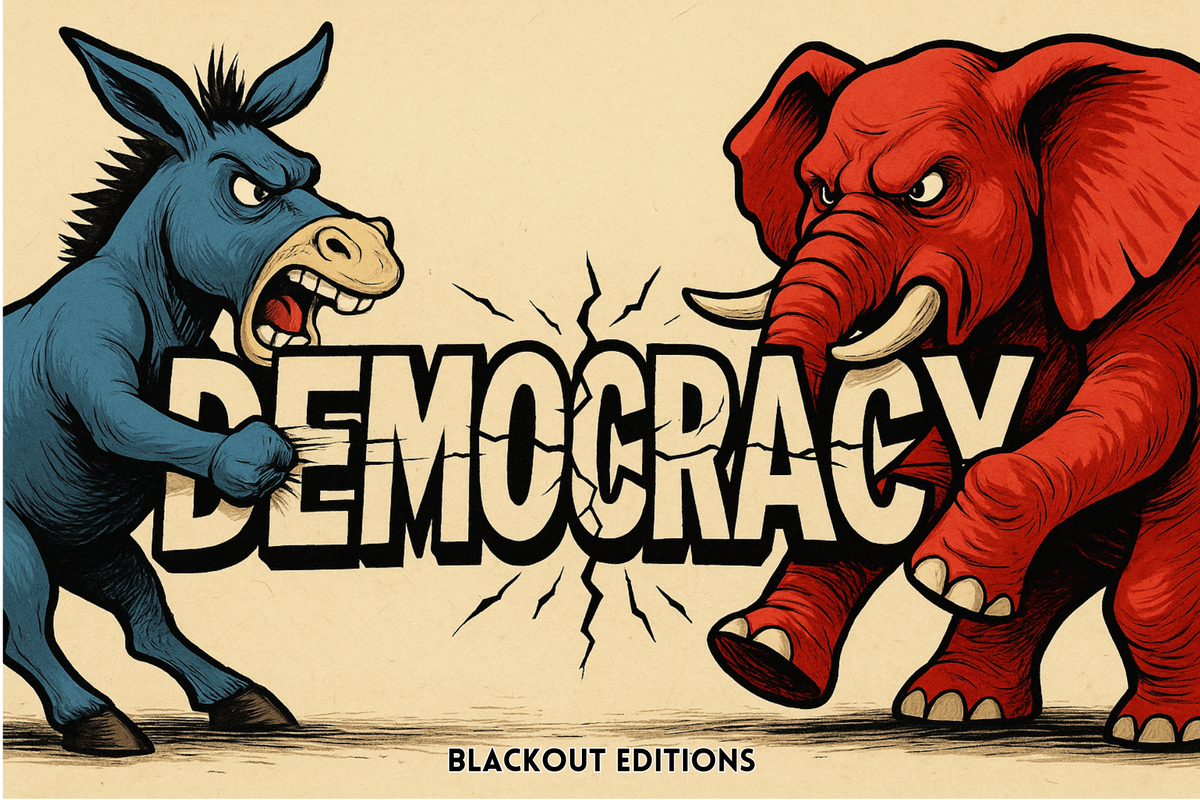
Democrats say they’re defending democracy — but what do they really mean? For the Left, democracy is faith in institutions. For the Right, it’s liberty and the people’s voice. Two sides, two definitions — and only one can endure.
Introduction: The Battle Over “Democracy”
In American politics today, one word echoes above all others: democracy. Democrats present themselves as its last defenders. Every speech, press conference, and campaign ad frames Donald Trump and his supporters as a “threat to democracy.” But what does that accusation actually mean?
For millions of voters, the phrase feels self-evident. Who wouldn’t want to defend democracy? Yet peel back the layers and a deeper reality emerges: the Left and the Right aren’t even speaking the same language. They use the same word — democracy — but define it in entirely different ways.
For the Left, democracy means safeguarding institutions: courts, agencies, elections, and media outlets. Question those institutions and you are “undermining democracy.”
For the Right, democracy means safeguarding the people: their sovereignty, their freedoms, their votes. Questioning institutions isn’t treason. It’s democracy in action.
And that’s why this debate matters. Until Americans confront these competing definitions, “threat to democracy” will remain a political weapon — wielded as a shield by the Left and a sword against the Right.
The Real Definition
At its root, democracy means rule by the people. From the Greek demos (people) and kratos (rule), it describes government by citizens, not kings or elites.
But America’s founders were careful: they rejected a pure democracy where 51% could erase the rights of 49%. Instead, they created a constitutional republic — where citizens rule through elections, but their rights are protected by laws, checks, and a Constitution.
That’s the real definition: a people who govern themselves, within a framework that guards liberty. Once democracy is redefined as faith in institutions, the next step is inevitable: protect the institutions at all costs — even at the expense of the people.
The Left’s Version of Democracy: Faith in Institutions
For the modern Left, democracy doesn’t mean rule by the people — it means rule through institutions. Courts, agencies, elections, and the media become the sacred pillars. If they’re intact and unquestioned, democracy is “safe.” Challenge them, and democracy is “under attack.”
In this worldview, institutions — not citizens — hold the final authority. Protecting democracy means protecting the system itself, not necessarily those it governs.
Elections Must Be Beyond Question
If democracy = institutions, then elections must be placed beyond scrutiny. Questioning results, procedures, or security is treated as heresy — an “attack on democracy.”
- Ballot harvesting has been legalized and normalized by Democrats, justified as “expanding access,” despite its potential for manipulation. Raise objections and you’re branded an “election denier.”
- Gerrymandering is condemned when Republicans do it, but reframed as “fair representation” when Democrats redraw maps in Illinois, New York, or California.
- The Census and illegal immigration are used to inflate representation by counting noncitizens, padding blue states with extra House seats and electoral votes.
- Voter ID laws — standard worldwide — are fought as “racist” or “suppression” in the U.S., even as states issue driver’s licenses and IDs to noncitizens.
The Pattern
Flood the system with ballots.
Redraw maps to secure seats.
Inflate representation through noncitizens.
Strip away verification.
Then brand critics a “threat to democracy.”
By redefining democracy as institutions, the Left equates protecting their control of the system with protecting America itself.
Federal Agencies Must Be Above Scrutiny
If institutions are democracy, then agencies like the FBI, DOJ, CIA, and DHS must be beyond challenge. They are framed as guardians of “truth.” To question them is to “undermine democracy.”
- FBI & DOJ pressured platforms during COVID to silence dissenting doctors, scientists, and journalists. The same playbook buried the Hunter Biden laptop as “Russian disinformation,” only to admit authenticity after the election.
- DOJ has labeled parents at school board meetings potential “domestic terrorists,” while downplaying Antifa or BLM violence.
- CIA veterans signed the infamous laptop letter — deliberate election interference framed as “patriotism.”
- DHS tried to launch a “Disinformation Governance Board,” openly proposing government censorship in the name of protecting democracy.
The Pattern
When the FBI censors stories, it’s “protecting voters.”
When the DOJ prosecutes selectively, it’s “defending the rule of law.”
When the CIA manipulates intelligence, it’s “safeguarding national security.”
These agencies aren’t neutral referees. They are the muscle behind the Left’s version of democracy — ensuring outcomes that keep the system in their hands.
The Media Must Control the Narrative
If democracy = institutions, the media’s role is to manufacture consent. Outlets call themselves “defenders of democracy,” but act as propaganda arms, deciding which stories the public hears and which disappear.
- COVID dissent was silenced as “misinformation.”
- Hunter Biden’s laptop was buried as “Russian disinformation,” only to be admitted authentic later.
- Riots, inflation, and border crises were softened or reframed as “talking points.”
- Every accusation against Trump — Russia collusion, Ukraine impeachment, the “very fine people” hoax — was amplified endlessly. Corrections came quietly, long after damage was done.
The Twitter Files revealed just how deeply media coordinated with government and platforms to suppress speech — all under the banner of “protecting democracy.”
And they cloak it in slogans: “Democracy dies in darkness.” “Free press = free people.” But in practice, “democracy” becomes their justification to silence dissent.
The Pattern
When they censor, it’s “protecting democracy.”
When they smear, it’s “fact-checking.”
When they bury stories, it’s “responsible journalism.”
The press doesn’t just report on democracy — it decides who gets to participate in it.
The Courts Must Deliver the “Correct” Outcomes
If institutions are democracy, then courts are the final shield. Judges aren’t neutral interpreters of law — they are expected to guarantee “the right outcomes.”
- Lawfare: endless indictments and injunctions drain conservative leaders and block voter-backed policies.
- Court-packing: openly discussed as “saving democracy” by ensuring permanent progressive majorities.
- Selective legitimacy: Roe v. Wade was sacred until Dobbs overturned it; then the Court was “illegitimate.” Republican gerrymanders are “suppression,” Democrat gerrymanders are “fair.”
The Pattern
Rulings for the Left = “democracy at work.”
Rulings against the Left = “threats to democracy.”
By redefining democracy as institutions, the courts become not arbiters of justice but enforcers of power.
The Right’s Version of Democracy: Liberty Over Institutions
For conservatives, democracy isn’t about protecting institutions from the people. It’s about protecting the people from institutions. America was never meant to be a pure democracy where 51% could erase the rights of 49%. Instead, the founders designed a constitutional republic — a system where liberty is safeguarded even when it’s unpopular.
Institutions are not sacred. They are tools, accountable to the people, and replaceable when they fail. The FBI, courts, and media do not define democracy. They are supposed to serve it. If they abuse power, conservatives argue, they become obstacles — not guardians — of self-government.
This vision of liberty over institutions plays out in practice through four key arenas: the ballot, sovereignty, fundamental freedoms, and decentralization.
Protecting the Ballot by Protecting the Voter
Where the Left floods the system with ballots, the Right insists on ballot integrity. For conservatives, democracy isn’t measured by how many envelopes are collected — it’s measured by whether every lawful citizen’s voice counts equally.
That’s why voter ID laws are seen as safeguards, not suppression. Around the world, from India to Mexico to nearly every European democracy, ID to vote is standard practice. Yet in America, Democrats brand it as “racist” or “anti-democratic.”
Republican states like Georgia, Texas, and Arizona have passed reforms requiring photo ID, banning ballot harvesting, mandating signature verification, and tightening mail-in procedures. Each time, they’re attacked in the media as trying to “restrict democracy.” But conservatives see it as the opposite — ensuring one person, one legal vote, counted fairly.
The Principle at Stake
Without ballot integrity, democracy becomes theater. A citizen who follows the rules shouldn’t have their vote canceled out by a harvested ballot collected in a nursing home, a fraudulent mail-in with no signature check, or a vote cast by someone with state-issued ID but no legal citizenship. Protecting the ballot protects the voter. Protecting the voter protects the republic.
Sovereignty Over Manipulation
For conservatives, democracy means self-government by citizens — not inflated representation through illegal immigration or Census manipulation.
Democrats push to count illegal immigrants in the Census, boosting representation in blue states like California and New York. That translates into extra congressional seats and Electoral College votes, even though noncitizens can’t legally vote. Meanwhile, states like Texas or Florida — which bear the costs of illegal immigration — see their citizens’ voices diluted.
This is why Republican-led states demand a citizen-only Census. It’s why they push laws blocking illegal immigrants from receiving benefits or IDs that blur the line between legal and illegal. Without citizenship as the anchor, conservatives argue, representation becomes manipulation.
The Principle at Stake
If representation is based on residency, not citizenship, then the very meaning of self-government collapses. Counting illegal immigrants hands political power to those who broke the law, while diminishing the voices of those who followed it. Democracy is not strengthened by erasing borders — it’s destroyed by it.
Liberty as the Supreme Safeguard
The Right insists that liberty — not bureaucracy — is democracy’s shield. Freedoms of speech, religion, and self-defense are not bargaining chips. They are guarantees that no majority vote or institutional decree can erase.
- Speech: Conservatives fought lockdown censorship and COVID debate suppression, arguing that once bureaucrats decide which voices are “allowed,” democracy dies in silence.
- Religion: Cases like Masterpiece Cakeshop and Little Sisters of the Poor revealed the Left’s willingness to drag citizens into court for refusing to violate their conscience. Conservatives see this not as tolerance, but tyranny.
- Self-Defense: The Second Amendment, affirmed in Bruen (2022), is treated as the final check. An armed citizenry is, in their view, the ultimate safeguard against state overreach.
The Principle at Stake
The ultimate threat to democracy isn’t losing an election. It’s losing the liberty that makes elections matter.
- A silenced people cannot vote freely.
- A disarmed people cannot resist oppression.
- A people stripped of conscience cannot govern themselves.
For conservatives, democracy endures only when liberty endures.
Decentralization and State Sovereignty
Conservatives argue that Washington, D.C. is not the heart of democracy — the states are. Federalism ensures power is divided, local, and accountable.
During COVID, states like Florida and South Dakota charted their own course, resisting Washington’s mandates. On education, red states have advanced school choice and resisted federal curricula. On cultural battles, states like Texas pushed back against federal gender ideology rules in schools. In each case, conservatives say democracy was preserved because citizens could influence local leaders — or vote with their feet.
By contrast, Democrats push to centralize power: federalizing election laws, overriding state abortion limits, suing states that try to secure their borders, and imposing one-size-fits-all regulations. To conservatives, this is not democracy — it’s managerial control from above.
The Principle at Stake
Democracy thrives when power is decentralized, because it gives citizens real choices and accountability. A union of states reflects the diversity of the nation. A centralized bureaucracy erases it. Federalism is not chaos — it is freedom.
Questioning Power as a Patriotic Duty
For the Left, questioning institutions is “attacking democracy.” For the Right, it is democracy.
From the Revolution against the Crown, to the abolition of slavery, to civil rights marches, America’s greatest leaps forward came from questioning authority. Conservatives see today’s fight the same way: when the FBI buries stories, when the DOJ prosecutes selectively, when the CIA manipulates intelligence, or when the media censors debate, silence is not patriotism. Resistance is.
The Principle at Stake
Democracy doesn’t die when institutions are challenged. It dies when institutions are placed above the people, shielded from accountability. Questioning power is not treason. It is loyalty to the principles of liberty and self-government.
This is where definitions collide — and what is lost if the more institutional version wins.
When Democracy Becomes Control — And the Choice We Face
The Left’s version of democracy doesn’t empower voters — it insulates the ruling class from them. Question authority, and you’re dangerous. Doubt the press, and you’re misinformed. Challenge elections, and you’re “anti-democracy.” By equating democracy with institutions, clinging to power becomes virtue. Every court ruling, every agency action, every censorship campaign is framed not as politics but as “defending democracy.” In this way, democracy becomes a mask for control.
But America now stands at a crossroads. One path tells us democracy is fragile — guarded by unelected officials, protected by censorship, and preserved by bending the rules. The other says democracy is strong — that it lives in the people themselves, and that liberty, not bureaucracy, is its shield.
If democracy means institutions, then questioning power is treason.
If democracy means liberty, then questioning power is patriotism.
The Left says they are defending democracy.
The Right says they are defending the people.
Both cannot be true. Only one definition will survive — and whichever one does will decide whether Americans remain citizens with sovereignty, or subjects managed by institutions.
Blackout Editions
No bios. No signatures. Just truth, in black and white.
👉 blackouteditions.com
💬 Disagree? Good. That’s the point.
This is a space for hard conversations—no filters, no apologies.
Subscribe to stay sharp. Share to keep others honest.