The Mental Health Meltdown: America’s Next Major Crisis
America’s youth are collapsing under anxiety, identity confusion, and over-medication. Liberal policies promised inclusion but delivered instability. Pills and hashtags won’t save them—truth, resilience, and discipline will.
A Generation in Collapse
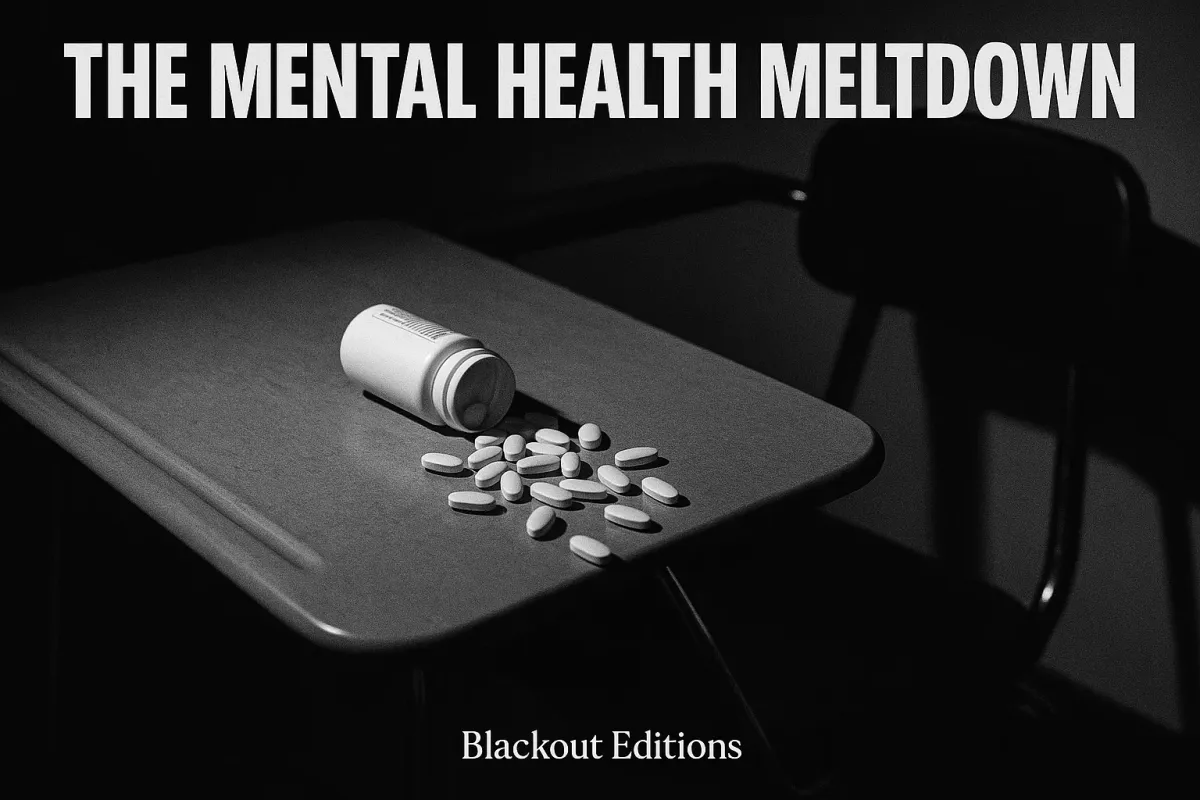
America is facing a crisis more dangerous than any headline will admit. Youth mental health isn’t just “worsening” — it’s imploding. Anxiety, depression, prescription dependency, gender confusion, suicide, and even mass shootings are all climbing at once.
The numbers alone tell the story. The CDC reports that 44% of high school students say they feel “persistently sad or hopeless.” Suicide is now the second leading cause of death among teens and young adults. ER visits for suspected suicide attempts among teen girls spiked by 51% in the last decade. Antidepressant prescriptions for minors are at record highs. And gun violence tied to young perpetrators — often accompanied by manifestos drenched in mental health struggles or identity confusion — is rising.
Experts and authors have been warning about this trajectory for years. Jonathan Haidt’s The Coddling of the American Mind traced the decline in resilience and the rise of anxiety linked to smartphones and social media. Abigail Shrier’s Irreversible Damage highlighted how gender ideology and social contagion magnified mental health struggles, especially among girls. Psychiatrist Dr. Thomas Szasz warned decades earlier that America was pathologizing normal struggles and replacing family and community support with endless diagnoses and prescriptions.
Yet instead of pumping the brakes, America doubled down. Social media remained unchecked. Schools embraced identity fluidity and self-diagnosis, encouraged by Biden administration policies that expanded Title IX protections to include gender identity and pressured schools to adopt “affirmation-first” approaches. Meanwhile, federal agencies loosened restrictions on telehealth prescribing, making it easier for minors to be placed on psychiatric medications without in-person evaluations. Pharma expanded its grip, turning adolescence into a prescription pipeline. And politicians and activists silenced critics by branding them as cruel, outdated, or intolerant.
The result? A generation staggered under its own contradictions. Told to “be yourself,” yet coached to question their identities endlessly. Encouraged to “speak up,” only to be drowned out by algorithms rewarding victimhood. Promised “help,” but handed pills and sent back to screens.
This isn’t a temporary downturn—it’s systemic collapse. And every ignored warning, every silenced critic, every rubber-stamped prescription has brought us here.
Identity or Instability?
Mental health has become inseparable from identity politics. What began as compassion has morphed into confusion. Young people are told they can choose their gender, swap identities like apps, or even adopt animal personas. Instead of grounding them, this destabilizes them.
The data is grim. LGBTQ+ youth report far higher rates of depression, anxiety, and suicide attempts than their peers. And recent mass shootings have increasingly included manifestos tied to identity struggles — proof that what begins as confusion can metastasize into violence.
Parents, meanwhile, are being cornered by professionals with a chilling ultimatum: “Affirm your child’s chosen identity, or they’ll kill themselves.”
This is not medicine; it’s emotional blackmail. Statistically, the majority of children who experience gender dysphoria eventually outgrow it and go on to live normal, productive lives when left to mature naturally.
The reality is more complex than activists admit. Suicide rates are not highest among kids whose parents say “wait” — they’re often higher among those who transition and later regret it, realizing the gender change never resolved their deeper unhappiness. Many were misled into believing gender was the root of all their problems, only to discover afterward that it wasn’t.
Other nations are waking up. Sweden, Finland, and the U.K. have all rolled back gender-affirming care for minors, citing long-term harm and lack of evidence. Sweden’s national health board announced that hormone treatments should only occur under strict clinical trials. Finland now prioritizes psychological support over medical interventions. Britain shut down the Tavistock Clinic — once the world’s largest youth gender identity center — after an independent review found reckless prescribing and systemic harm.
Meanwhile, America is sprinting in the opposite direction. Schools teach identity fluidity as fact, encouraged by federal guidance. State legislatures compete to codify “affirmation-first” policies. Critics are branded intolerant. Instead of learning from the international course correction, America is doubling down on the very approach others are abandoning.
The result is a generation raised in chaos, with their sense of self outsourced to ideology and algorithms. Stability has been traded for experimentation — and kids are paying the price.
However, recently - the Trump administration has launched a full-scale rollback of identity-based support:
- Declared biological sex as immutable and rescinded transgender protections across federal agencies. Gender identity is no longer recognized in passports, benefits, or federal documentation.
- Through Executive Order 14187, effectively banned puberty blockers, hormone therapy, and surgeries for minors, branding such care as “chemical and surgical mutilation.” Hospitals and clinics across the country quickly paused youth-affirming procedures in response.
- Implemented Executive Order 14190, criminalizing educators who facilitate gender transitions. Referrals, pronoun use, access to restrooms, and other recognitions of gender identity could now expose teachers and administrators to prosecution.
- Rescinded Biden-era directives under Title IX that extended protections to gender identity, reverting back to rules that define sex strictly as biological. Students are barred from participating in sports or accessing facilities that align with their chosen identity.
- Threatened to withhold federal funding for sex education programs unless states remove all references to transgender issues and “gender ideology,” pushing an ideological crackdown into classrooms in nearly every state.
These actions mark more than just policy adjustments — they represent an ideological campaign to reshape how America defines identity in law, education, and healthcare. Where the Biden administration encouraged affirmation and expansion, the Trump administration is drawing a hard line of restriction and reversal.
And while identity politics destabilizes kids in schools and clinics, the accelerant comes from their phones. Social media has turned confusion into contagion.
The Social Contagion Effect
Mental health doesn’t spread in isolation anymore — it spreads like wildfire. Social media has turned personal crisis into public theater. Depression, gender dysphoria, suicide attempts, even acts of violence are now broadcast, rewarded, and copied. What once might have been a private struggle becomes a viral template for others to imitate.
The platforms know it too. Algorithms don’t care if the content is healthy or destructive — they only care if it spreads. Self-harm “communities” multiply, pushing eating disorders as lifestyles. Videos glorifying gender transitions rack up millions of views, celebrated as identity revolutions. Violent screeds circulate faster than any warning label or parental filter can catch. Crisis has become content, and content is rewarded with clicks.
This is why teen mental health curves don’t just slope upward — they spike. Copycat behavior is now instant, global, and reinforced. A suicidal thought doesn’t fade; it’s echoed back by thousands of others online. A confused teen isn’t grounded by family; they’re affirmed by strangers pushing them deeper into instability. A violent fantasy isn’t suppressed; it’s sharpened by algorithm-fed communities that normalize rage.
The latest horror illustrates how lethal this contagion can become. On August 27, 2025, a 23-year-old transgender individual opened fire during a morning Mass at Annunciation Catholic School in Minneapolis. The attacker murdered two children, wounded 17 more, and left behind a video manifesto filled with grievance, identity conflict, and praise for past shooters. Just like the Nashville massacre in 2023 — where the shooter’s writings revealed deep identity confusion and rage — this crime was not random. It was patterned. It was contagious.
And in a generation raised with phones in their hands before they can drive, the accelerant of digital validation is pouring gasoline on already fragile minds.
When that fire finally consumes kids, America’s answer isn’t to give them discipline, truth, or reality — it’s to hand them a prescription.
Instead of grounding a generation, we’re drugging it.
The Pill Prescription Nation
America has built a system where every adolescent struggle is pathologized, labeled, and medicated. Sadness is depression. Energy is ADHD. Nerves are anxiety disorder. Instead of confronting the messy realities of growing up, we’ve turned childhood itself into a clinical condition — and Big Pharma is cashing in.
Nearly one in five children and teens in America is now on psychiatric medication. Antidepressants, anti-anxiety drugs, ADHD stimulants — prescriptions that once were rare are now routine. Between 2003 and 2015, ADHD diagnoses doubled. By 2020, prescriptions for antidepressants in minors had risen more than 40% compared to the previous decade. Entire school systems quietly adjusted policies to deal with side effects: lethargy, agitation, even increased suicidal thoughts.
The COVID era supercharged the problem. With telehealth, controlled substances like Adderall and Xanax could be prescribed in a 15-minute video call. Federal agencies loosened safeguards that once required in-person evaluations. Start-ups and online “wellness clinics” flooded TikTok and Instagram with ads promising focus, calm, and confidence — all delivered by mail in a discreet bottle. By 2022, the DEA was reporting nationwide Adderall shortages, not because of sudden medical necessity, but because prescribing had exploded.
Meanwhile, lawsuits continue to pile up. Families have sued drugmakers for failing to disclose the risks of SSRIs like Prozac and Zoloft, which studies show can actually increase suicidal ideation in some teens. In one well-known case, a 12-year-old boy prescribed antidepressants for “mild anxiety” died by suicide within weeks. His parents later discovered the drug carried an FDA black box warning — the most serious alert available — about that very risk.
Even the new Secretary of Health has stepped in, openly warning that America is drugging its children into dependence. Unlike his predecessors, he has called for reducing psychiatric prescriptions for minors and pushing healthier, non-pharmaceutical approaches. His message is simple: too many kids are being handed pills instead of being taught to cope, grow, and recover. Whether his agenda can overcome the entrenched power of Big Pharma and a culture addicted to quick fixes remains to be seen — but at least, finally, someone at the top is saying what parents have known all along.
But still the pipeline grows. Kids are told that feeling restless, sad, or insecure isn’t part of adolescence — it’s a diagnosis. Parents, often desperate for solutions, lean on prescriptions because schools encourage it and doctors normalize it. For Pharma, the business model is perfect: medicate them young, keep them medicated for life.
But the numbers mask the deeper problem: pills don’t cure causes. They flatten symptoms. Instead of asking why a generation is buckling under anxiety, depression, and confusion, we medicate the despair. Instead of fixing family structures, broken schools, or the addictive grip of social media, we drug kids until they’re manageable.
The consequences are everywhere. Young adults describe themselves as “chemical captives” — starting medication as teenagers, then cycling through endless cocktails in their twenties, never learning to cope without a bottle. America’s chosen solution isn’t to give kids resilience, grounding, or truth. It’s to keep them chemically sedated.
Where It’s Worst
The youth mental health crisis does not hit every corner of America equally. Look closely, and a pattern emerges: the worst outcomes are concentrated in states with the most aggressive liberal policies on identity and affirmation.
Oregon tops the nation in youth depression, with nearly a quarter of teens reporting a major depressive episode. Washington, California, New York, and New Jersey follow closely — all states that lead the country in pushing identity fluidity as fact, mandating affirmation-first policies in schools, and embedding gender ideology into classrooms. Yet rather than stabilizing children, these states are producing some of the most fragile and medicated youth populations in America.
This pattern is impossible to ignore. States that embrace affirmation at every turn consistently report higher rates of adolescent depression, anxiety, and suicide attempts. Campaigns promising inclusion have instead created instability. Policies that tell kids they can redefine their identity endlessly, combined with pressure on parents to affirm or risk losing their child, are fueling the very chaos they claim to prevent.
Contrast this with more traditional states, where schools have resisted these policies. Suicide rates and adolescent depression remain lower, even with other risk factors like rural isolation or economic hardship. The common denominator in the worst-performing states is not geography — it’s ideology.
For years, Americans were told that openness, affirmation, and progressive policy were the answer. But the map tells a different story. The states most committed to those ideas are the very places where kids are hurting the most.
Beyond Awareness
For years, America has been drowning in slogans. Every May is “Mental Health Awareness Month.” Schools post hashtags. Corporations change their logos to pastel green. Politicians hold press conferences about compassion. And yet the numbers keep climbing. Awareness hasn’t saved kids — it has normalized collapse.
Young people don’t need another ribbon campaign. They don’t need schools teaching them 50 genders. They don’t need doctors handing them another pill bottle. What they need is stability. Discipline. Family. Truth. They need adults willing to tell them that life is hard, that struggle is normal, and that resilience is possible.
But our institutions refuse. Pharma keeps filling prescriptions. Schools keep pushing ideology. Tech companies keep feeding algorithms that profit from despair. Politicians keep promising “compassion” while silencing anyone who challenges the orthodoxy. Meanwhile, a generation slips further away — confused, fragile, over-medicated, and searching for answers they’ll never find in hashtags or hormones.
This is America’s next major crisis, and it’s already here. Pretending it will be solved with more slogans and more pills is a lie. Until we are willing to admit the truth — that kids need grounding, not affirmation; resilience, not sedation; honesty, not hashtags — the collapse will continue.
That’s why Blackout Editions exists: to call it what it is, not what they say it is. To ask the question leaders avoid: when did protecting the story become more important than protecting the people?
Blackout Editions
No bios. No signatures. Just truth, in black and white.
👉 blackouteditions.com
💬 Disagree? Good. That’s the point.
This is a space for hard conversations — no filters, no apologies.
Subscribe to stay sharp. Share to keep others honest.