
The Great Conflation: Why “Political Experience” Isn’t Real Life Experience
Career politicians dominate both parties, spending decades in office without real-world experience. They legislate from theory, not reality, while the media praises their tenure. The result: policies detached from everyday life — and problems they helped create only get worse.
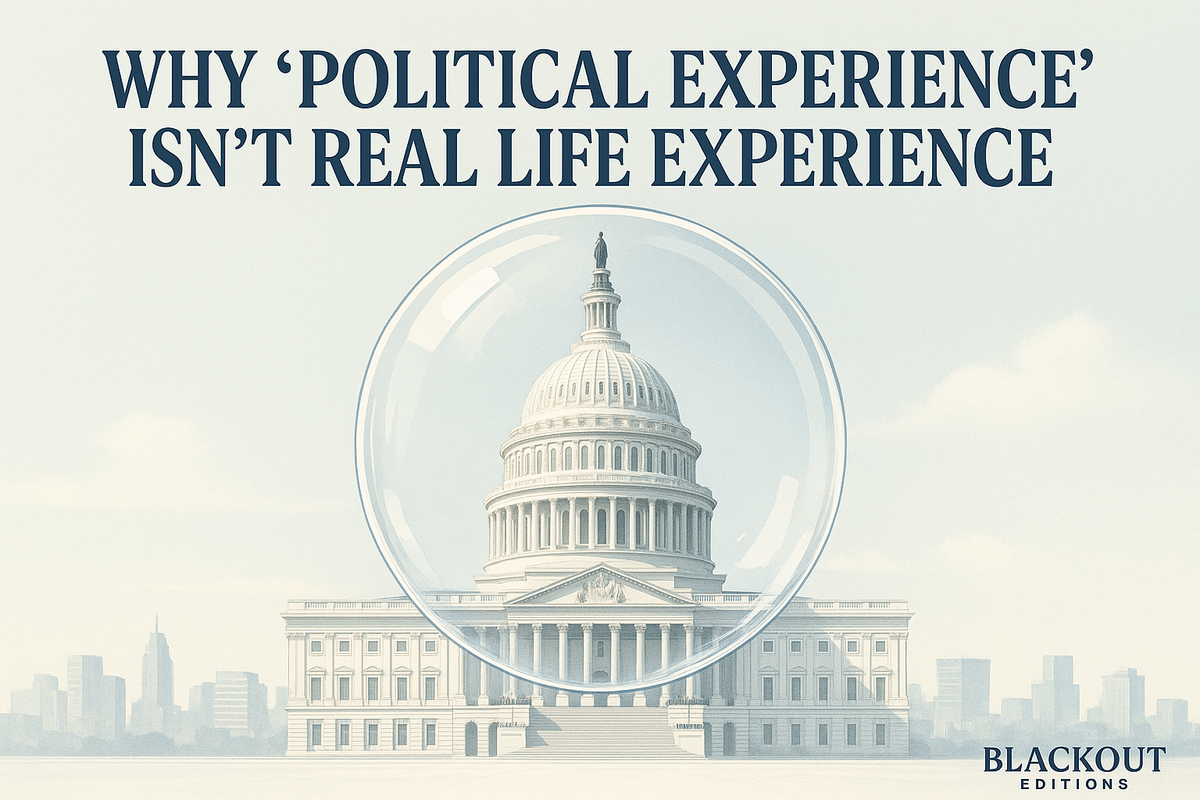
One of the most destructive myths in American politics is the belief that “political experience” equals competence — or that it’s the kind of experience that actually benefits the country.
The media pushes it.
Incumbents brag about it.
Voters fall for it.
But decades in politics don’t make someone a better leader. It makes them better at surviving inside the political bubble — while becoming completely disconnected from the real world.
The truth? “Political experience” often means decades of speeches, handshakes, and self-preservation — not decades of solving real problems.
The Career Politician Problem
One of the biggest failures in American governance is that we keep electing people who have spent their entire adult lives in politics. They’ve never worked in the industries they regulate, never lived under the full weight of the policies they pass, and never had to meet a payroll or compete in the free market. Yet they decide tax rates, energy policy, labor laws, and healthcare regulations for the rest of us.
And this is not a partisan issue. From both sides of the aisle, there’s a long list of leaders whose “experience” begins and ends within the political bubble.
Here are some well-known examples:
Democrats
Chuck Schumer — In Congress since 1981, straight out of Harvard Law. No private-sector job history, no business ownership, no experience navigating the real-world economy. Yet for over forty years, he’s helped write the tax and regulatory policies that shape the lives of millions.
Nancy Pelosi — Entered Congress in 1987 after years in party politics and fundraising. No background in manufacturing, healthcare, or small business — only in political organizing and deal-making within the party structure.
Joe Biden — Elected to the Senate at 30 in 1973, directly from law school and local politics. More than fifty years in office without ever running a business or working in an industry subject to the laws he’s passed.
Elizabeth Warren — Spent most of her professional life in academia as a law professor before entering politics. While she built a reputation as a consumer advocate, she’s never run a business or worked in the private sector she so often critiques.
Bernie Sanders — Worked odd jobs in his early years, but has spent the last four decades in elected office, from mayor to congressman to senator. Known for railing against the wealthy, yet has never worked in the kinds of private-sector roles that produce jobs or manage payroll.
The Progressive Paradox
Many of these same Democratic leaders have amassed personal wealth far beyond what their government salaries would reasonably allow, often through book deals, investments, and family connections. Yet they campaign on the idea that “the rich” should pay more in taxes — while making no voluntary contributions themselves beyond what the law requires. It’s a case of do as I say, not as I do that erodes the moral high ground they claim to hold.
When they say “the rich should pay more,” they’re talking about everyone else — never themselves.
Republicans
Mitch McConnell — In the Senate since 1985. Before that, worked as a legislative aide and in local government. His entire career has been in politics, with no private-sector management or entrepreneurial experience.
Lindsey Graham — Entered Congress in 1995 after a short stint as a military lawyer (JAG). Nearly thirty years in Washington without private-sector leadership experience.
Orrin Hatch (retired 2019) — Served 42 years in the Senate. Aside from practicing law before his political career, he spent his entire professional life in elected office.
Roy Blunt (retired 2023) — In politics almost continuously since the 1970s, moving from local to federal office without significant private-sector work.
Thad Cochran (served until 2018) — A lawyer before his 40-year Senate career, with no experience managing a business or working in the industries affected by his legislation.
The Outsider Contrast
Compare that with leaders who’ve lived outside the bubble:
- Donald Trump — Built companies, employed thousands, navigated bankruptcies and recoveries — real stakes with real consequences.
- J.D. Vance — Grew up in poverty, served in the Marines, worked in business and law before running for office.
- Ron Johnson (R-WI) — Built a manufacturing company before entering politics.
- Tulsi Gabbard (former D-HI) — Served in the military and ran a small business before Congress.
Agree or disagree with their politics, these people know what it’s like to operate in the real world — where failure costs more than bad press and a bruised ego.
Why This Matters
When leaders spend their lives inside the political bubble, they legislate from theory, not reality. They create regulations they’ve never had to follow, impose taxes they’ve never had to pay as business owners, and pass laws without ever feeling the real-world consequences.
The growing wealth of many of these politicians — while worth noting — is a byproduct of the system. The deeper problem is that they govern without ever having lived under the conditions they impose on the people they represent.
The longer someone lives in that bubble, the more disconnected they become. Eventually, their entire sense of “experience” is based on meetings, votes, and speeches — none of which teach them what it’s like to live under the policies they create.
Not Just Washington: The State-Level Echo
Career politics doesn’t end in Congress—it shows up in governors’ mansions, too. Governors like Gavin Newsom have spent the majority of their adult lives in power, with little to no private-sector experience to ground their understanding in the real world.
Gavin Newsom — Governor of California since 2019, but a fixture in politics for more than 25 years—from the San Francisco Board of Supervisors to mayor, then lieutenant governor, before ascending to the governorship. He’s spent his entire adult life within the political bubble, while Californians face soaring living costs, a worsening housing crisis, and deteriorating infrastructure. These aren’t problems he’s had to endure personally under the policies he enacts.
And California is not alone. States across the country have governors who, like their congressional counterparts, have spent decades in public office without significant time in the private sector. The result is the same: policy crafted in theory, detached from the reality citizens face every day.
It’s the same story as Washington — long political résumés, short real-world experience, and a track record of worsening problems.
The Media’s Role
The press reinforces the myth of the career politician by treating longevity as a virtue in itself. The narrative is that “decades of service” automatically equal wisdom and competence — as if time in office were the same thing as quality of service.
Every election cycle, we hear it in debates and interviews:
- “Senator X brings 30 years of experience to the job.”
- “Representative Y is a seasoned statesman.”
What’s rarely questioned is experience in what?
In most cases, it’s experience in campaigning, fundraising, and maneuvering through party politics — not in solving problems that exist outside the Beltway.
In the real world, decades spent in a closed, consequence-free environment don’t make you a better leader — they make you more insulated, less adaptable, and more dependent on the system that sustains you. A CEO who fails for 30 years doesn’t keep their job. A surgeon who makes repeated mistakes isn’t celebrated for their “long career.”
But in politics, time served becomes a badge of honor. The longer you’ve been in, the more deference you get from the media, even if your record shows more speeches than solutions.
It’s like hiring a pilot who’s only ever flown a simulator and expecting them to land a real plane in bad weather. They might know the procedures by heart — but they’ve never felt the turbulence, never made a life-or-death decision in real time, and never had to face the consequences if they got it wrong.
By elevating tenure over real-world competence, the media helps keep career politicians in power — and keeps the cycle of disconnected, theory-based governance alive.
Breaking the Cycle
We keep re-electing career politicians because we’ve been sold the myth that Washington tenure equals competence. The truth? It’s often the opposite. Time in politics teaches you how to win elections, not how to solve problems.
Part of the problem is structural. Incumbents benefit from name recognition, built-in donor networks, and a media that treats them as “established” leaders. They campaign with taxpayer-funded travel, hold press events in front of friendly local outlets, and position every routine duty as proof of effectiveness.
Voters fall into the trap of thinking, Better the devil we know than the one we don’t. But in doing so, we keep empowering the same people who created the very problems they now promise to fix.
Until voters start valuing real-life experience over political survival skills — and demanding transparency in wealth gains — nothing will change. That means asking candidates not just what they believe, but what they’ve actually done outside of politics.
If we keep sending bubble-dwellers to Washington — and to our state capitols — we shouldn’t be surprised when they fail to fix the problems they helped create. The solution starts with us — at the ballot box, at the debate stage, and in every conversation where the myth of “political experience” goes unchallenged.
The Case for Term Limits
If we want to break the cycle of career politicians, we need structural guardrails — and term limits are one of the most effective. Without them, incumbents can cling to power for decades, using name recognition, donor networks, and media access to keep challengers at bay.
Term limits force turnover, bring in fresh perspectives, and reduce the incentive to govern for reelection instead of results. They also limit the time politicians have to entrench themselves in the system, build personal wealth off the position, or lose touch with the realities their constituents face.
Critics argue that term limits remove “experienced” lawmakers — but as we’ve seen, decades in politics often produce skill at campaigning, not problem-solving. Experience in the real world matters far more than knowing every trick of the legislative game.
Until we set reasonable limits on political tenure, Washington will remain a bubble — insulated, self-serving, and allergic to change.
And if we want policies grounded in reality, we need leaders who have lived in it.
Blackout Editions
No bios. No signatures. Just truth, in black and white.
👉 blackouteditions.com
💬 Disagree? Good. That’s the point.
This is a space for hard conversations—no filters, no apologies.
Subscribe to stay sharp. Share to keep others honest.